REVIEW · EDINBURGH
Ghosts of Edinburgh: Bloody Past Exploration Game and Tour
Book on Viator →Operated by Questo · Bookable on Viator
Edinburgh ghosts, minus the tour group chaos. This self-guided game tour turns major landmarks into puzzle stops, so you can wander the city at your own pace while learning the darker stories behind the skyline. Best of all, it’s designed to run offline, so you’re not stuck hunting for signal in stone streets.
I especially like the start-and-stop flexibility. You choose when to begin, you can take breaks, and you can resume later without needing a timed guide. I also like that the route feels built for “look closer” wandering—each location comes with a challenge that pushes you to notice details you’d otherwise miss.
One thing to consider: the experience depends on your phone and the app experience. If your phone stalls at login or you’re forced to walk farther than expected between clue points, the fun can dip—so plan for battery life and comfortable shoes.
In This Review
- Key highlights that make this game tour work
- Price and what you’re really paying for
- How the offline puzzle format changes the Edinburgh walking game
- Your haunted route: from The Mound to Old College
- Stop 1: The Mound (between Old Town and New Town)
- Stop 2: Edinburgh Castle
- Stop 3: St Giles’ Church (and the patron saint story)
- Stop 4: Mary King’s Close (the under-street close)
- Stop 5: Greyfriars Bobby Fountain (the Bobby legend in bronze form)
- Stop 6: The Grassmarket (where daily life turned grim)
- Stop 7: New College (Free Church roots)
- Stop 8: Scottish National Gallery of Modern Art (Modern One and Modern Two)
- Stop 9: Old College on South Bridge (University life in stone)
- When to play: day vs night for best atmosphere
- Who this experience suits best (and who should think twice)
- Booking smart: how to get the best value
- Should you book Ghosts of Edinburgh?
- FAQ
- How long does Ghosts of Edinburgh last?
- Where does the game tour start and end?
- Can I choose my own start time?
- Do I need an internet connection to play?
- Is there a physical tour guide with you?
- Is it available in English?
- How does the tour work if our group is large?
- Is this a private experience?
- Do I need to enter paid attractions like Edinburgh Castle to play?
- What if plans change—can I cancel?
Key highlights that make this game tour work
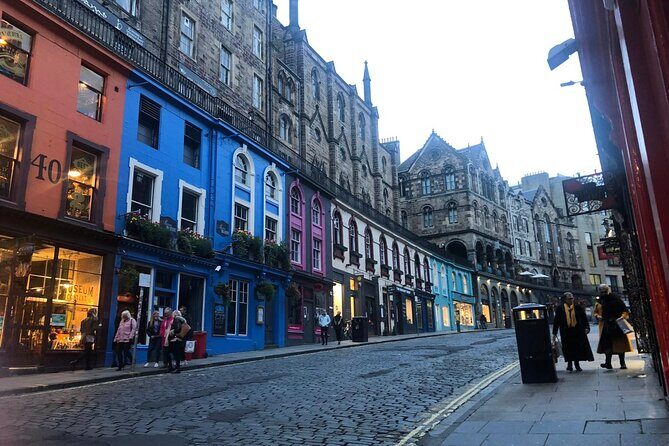
- Offline puzzles mean you can keep playing even with spotty phone coverage
- Start anytime, pause anytime keeps the pace friendly for families and friend groups
- A legend-heavy route hits places like Mary King’s Close and Greyfriars Bobby
- Self-guided and private means you control the flow of the walk
- Designed for exploration: you’re encouraged to scan, read, and hunt for answers in each spot
Price and what you’re really paying for

At about $7.21 per person, this is one of the cheapest ways to get a structured “wandering” plan through central Edinburgh. The value isn’t in a guide’s talking time—it’s in the game format: the curated route, the puzzles, and the prompts that turn famous spots into something interactive.
That low price comes with the tradeoff: you’re paying for an app-led experience, not a human-led one. If you like phones as part of travel (and you’re comfortable solving clue-style tasks), this feels like a smart buy. If you hate app friction—loading screens, logins, and “where do I go next?” moments—you may find the cost too easy to justify only once.
A few more Edinburgh tours and experiences worth a look



How the offline puzzle format changes the Edinburgh walking game
This is a Questo game-style tour, and the rules are refreshingly traveler-friendly:
- You don’t need a live physical tour guide.
- You can play without internet connection.
- You get a mobile ticket for the experience.
- You can play it anytime after booking without rescheduling.
In practical terms, that means you’re not chained to a specific departure time or group tempo. Want to arrive early and get your bearings near The Mound? Do it. Want to linger for a photo or duck inside for a quick rest? You can.
It’s also private in the sense that you’re not merged into strangers’ logistics. Only your group participates, which helps when you’re coordinating kids, teens, or friends who don’t all walk at the same speed.
Your haunted route: from The Mound to Old College
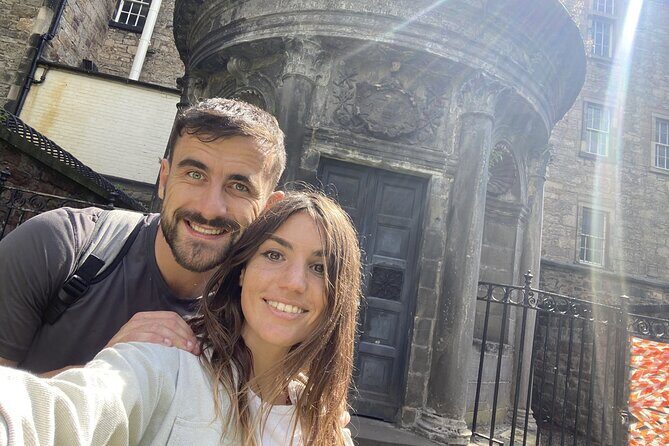
The walk is built around some of Edinburgh’s most recognizable “beats,” but it’s not a straight-line sightseeing list. Each stop has a challenge that nudges you to look around, read what you can, and search for the answer before moving on.
Here’s what that means at each landmark—and where you might need to plan extra time.
Stop 1: The Mound (between Old Town and New Town)
You begin at The Mound at Princes Street Gardens. This artificial slope connects Edinburgh’s Old and New Towns, and it exists because of the engineering story behind the city. The earth for it came from excavations for the New Town, dumped into Nor Loch (which was drained in 1765).
Why it’s a great opener in a game: it’s a natural “stage-setting” location. You’re in the middle of a city contrast, so the puzzles make more sense once you understand the geography. If you’re starting in late daylight, you can also take a moment to get views toward the castle area before you move.
Small consideration: this is an area you’ll likely want to scan slowly. If you’re rushing, you may miss the details the game nudges you toward.
Stop 2: Edinburgh Castle
Next is Edinburgh Castle, dominating the skyline from Castle Rock. Archaeology shows people have occupied the rock since at least the Iron Age—though the earliest settlement details are less clear.
Castle as a puzzle stop is smart because there are so many textures to look at: stonework, angles, and signage. The game format also encourages you to slow down instead of just snapping photos and walking off.
Important practical tip from how the experience is designed: you don’t need to enter ticketed attractions to play the game. If you run into a spot that feels like it’s asking you to pay just to proceed, know that the game should be playable without requiring paid entry.






Stop 3: St Giles’ Church (and the patron saint story)
Then you’ll arrive at St Giles’, with origins around 1130, when a parish church served Edinburgh during King David I’s reign. The church was granted to the Lazarites, and it was dedicated to St Giles, patron saint of lepers—and later associated with Edinburgh itself.
This is where the game format helps a lot. When you hear a quick church-history talk, it can blur together. Here, the puzzle approach pushes you to engage with the place physically, and that makes the “why this saint matters here” story stick.
What to watch: church details can be visually busy. If your puzzle screen isn’t reading smoothly in bright weather, try stepping to a quieter angle so you can zoom and focus.
Stop 4: Mary King’s Close (the under-street close)
Next up is Mary King’s Close, a historic close under buildings on the Royal Mile in Edinburgh’s Old Town. It’s named for Mary King, a merchant burgess who lived there in the 17th century.
This stop is perfect for a spooky game, even if you’re not looking for full-on horror. The whole idea of living and walking in layered Edinburgh—above and below—makes the legend vibe feel real. The puzzle mechanic also nudges you to notice how the space is shaped, not just what the landmark is called.
Practical note: closes and stair-y areas can feel tight. If your group includes older adults or small kids, move carefully and keep an eye on spacing so nobody gets left behind.
Stop 5: Greyfriars Bobby Fountain (the Bobby legend in bronze form)
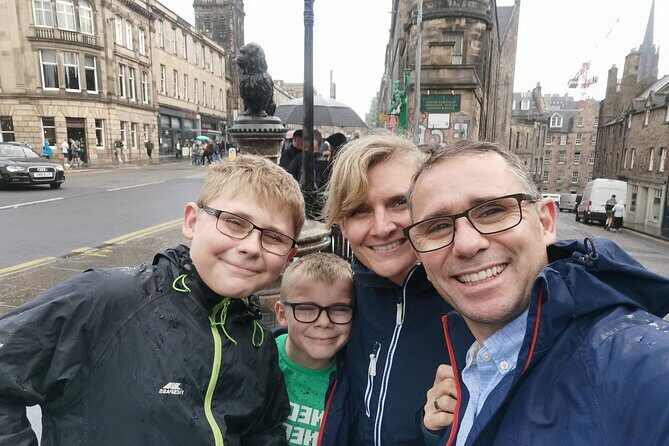
Then comes the Greyfriars Bobby Fountain, anchored by a life-size statue of Greyfriars Bobby created by William Brodie in 1872. It was paid for by Baroness Burdett-Coutts and unveiled on 15 November 1873. The statue sits near the south (main) entrance to Greyfriars Kirkyard.
This stop is a favorite kind of Edinburgh moment: a story you’ve probably heard before, now placed right where the legend lives. In a game tour, that’s valuable because the puzzle prompts often lead you to the statue context—so the story doesn’t feel like trivia, it feels like a place.
If you’re playing at night, this is one of the stops that can feel extra atmospheric, since the area’s mood supports the theme without needing any special effects.
Stop 6: The Grassmarket (where daily life turned grim)
Next you’ll reach The Grassmarket, dating back to the 1300s. It started as cattle fairs and stables, then became a trading point around the 1670s. Later, it also became a traditional public execution site, which is why the vibe can turn darker fast.
For a puzzle tour, this is a strong “tone shift” stop. You move from the warmth of famous stories into a space connected with harsh public punishment. Even if you’re not trying to scare yourself, it gives the game its bite.
What helps here: take a minute to look around at the layout. The game challenge makes more sense when you understand where people would have stood and watched.
Stop 7: New College (Free Church roots)
Then it’s New College, founded as the theological college of the Free Church of Scotland. Classes started in Edinburgh’s New Town on 1 November 1843, then moved to The Mound soon after. Rev Dr Thomas Chalmers laid the foundation stone for the current building on 3 June 1846.
This is a great stop for people who like architecture and institutional stories. It’s not just “another old building”—it’s connected to a specific religious education timeline. The puzzle format keeps it from turning into a lecture; you’re actively searching for answers as you take in the façade and setting.
Practical thought: since New College is part of an urban environment, keep your phone brightness comfortable so you can read challenges without squinting.
Stop 8: Scottish National Gallery of Modern Art (Modern One and Modern Two)
Next is Scottish National Gallery of Modern Art area. It first opened in August 1960 at Inverleith House in the Royal Botanic Garden. It moved to its present site at Modern One on Belford Road in 1984, and Modern Two opened across the road in March 1999.
This is an interesting pairing inside a haunted-themed route. Modern art might sound like it breaks the mood, but that contrast can be the point: Edinburgh isn’t one era—it’s layers. The game turns the transition into a challenge rather than a detour.
If you’re tempted to go inside and see exhibits, remember this is a game-based walking experience. The game is designed to be played without you needing to treat each stop like a museum ticket.
Stop 9: Old College on South Bridge (University life in stone)
Finally, you end at Old College on South Bridge, part of the University of Edinburgh. It now houses parts of university administration, the University of Edinburgh School of Law, and the Talbot Rice Gallery. Originally called the New College, it was designed by Robert Adam to replace older buildings.
Ending here makes sense because it’s a focal point in central Edinburgh, and it ties the route together with the theme of learning and tradition—ghosts aside.
Your official end point is 100 W Bow, Edinburgh EH1 2HH, UK, so expect to finish near the central university-adjacent area rather than somewhere far out.
When to play: day vs night for best atmosphere

If you want the theme to feel extra alive, night can be great. The game’s “bloody past” style fits the lighting and shadows of central Edinburgh.
That said, the biggest practical issue with night play is not fear—it’s your phone. If you’re starting late, give yourself extra time for the app to load and for you to settle into the flow. One recurring frustration reported with similar app tours is slow account loading, and that’s harder to troubleshoot when it’s dark and you’re already walking.
My simple plan:
- charge your phone fully
- pack a compact power bank if you have one
- start with enough daylight to orient, even if you finish after dark
Who this experience suits best (and who should think twice)
I think this is a strong fit for:
- Families who enjoy puzzles and can handle short-to-medium walking segments
- Friend groups who like light competition and team problem-solving
- People who prefer to control timing instead of joining a fixed schedule
It’s less ideal if:
- you strongly dislike app-based directions
- you expect a spoken guide to explain everything
- you hate reading small details outdoors
Also, because it’s a private activity limited to your group, it’s a good choice if you don’t want to manage cross-group pacing.
Booking smart: how to get the best value
This game is easy to justify on value alone because you’re paying per person for a 1-hour-or-so structured walk, plus offline capability and flexibility. It’s also booked in advance often (about 21 days on average), which hints that it stays popular.
My advice: book sooner rather than later if your dates are busy. And once you book, pick a start time when you won’t feel rushed—because you’re the one steering the pace.
Should you book Ghosts of Edinburgh?
Book it if you want a cheap, interactive way to explore central Edinburgh with a clear walking path and puzzles that make you look at landmarks more closely. The mix of major sites (Edinburgh Castle, St Giles’) plus storytelling stops (Mary King’s Close, Greyfriars Bobby, The Grassmarket) is a solid Edinburgh sampler without the “stand and listen” problem.
Skip it or approach with caution if you know you’ll be frustrated by app loading delays or by “figure out the next step” moments. In that case, it might feel like paying for technology instead of for a tour.
If you book, I’d treat it like a self-guided evening walk with added puzzles—not like a guided lecture. That mindset matches how the experience is built, and it’s usually the difference between a fun night and a “why are we walking so much?” mood.
FAQ

How long does Ghosts of Edinburgh last?
It’s listed as about 1 hour.
Where does the game tour start and end?
You start at The Mound, Edinburgh EH2 2EL, UK and end at 100 W Bow, Edinburgh EH1 2HH, UK.
Can I choose my own start time?
Yes. You get full flexibility to start at any hour, and you can begin within the service window listed as 12:00 AM to 11:59 PM daily.
Do I need an internet connection to play?
No. You can play offline, so you do not need internet connection to participate.
Is there a physical tour guide with you?
No. A physical tour guide is not included.
Is it available in English?
Yes. The experience is offered in English.
How does the tour work if our group is large?
If your group is larger than 15 people, the setup is handled by making multiple bookings.
Is this a private experience?
Yes. It’s described as a private tour/activity, so only your group participates.
Do I need to enter paid attractions like Edinburgh Castle to play?
Entrance to paid attractions is not required to play the games.
What if plans change—can I cancel?
You can cancel up to 24 hours in advance for a full refund. Canceling less than 24 hours before the start time means the amount paid is not refunded.
If you want, tell me your travel month and whether you’re going day or night, and I’ll suggest a simple timing strategy so the puzzles feel smooth.