REVIEW · GLASGOW
Glasgow Afternoon Tea Experience
Book on Viator →Operated by Red Bus Bistro Company Limited · Bookable on Viator
Vintage bus tea beats the usual tour. I like the handmade sandwiches and warm scones, served right on the bus as you roll past some of Glasgow’s best-known sights. I also enjoy how the crew keeps the mood light and fun, with laughs and even a singalong when the day calls for it. One thing to plan for: the vintage seating can feel tight, especially if you land in the less spacious spots.
You’ll get a smooth “see a lot without walking yourself into a new ankle” kind of outing. The menu is generous by afternoon-tea standards, and unlimited tea and coffee makes the whole thing feel like a real meal, not a snack. The tradeoff is that this is not built like a full, narrated sightseeing tour with deep commentary at every turn.
If you want a compact introduction to Glasgow that mixes comfort food with views, this works. Just come with the right expectations: think dining-first, quick city highlights, and a bus that has character because it is old.
In This Review
- Quick hits before you book
- Vintage Routemaster Meets Afternoon Tea: The Big Idea
- Getting On Board at Shuttle Street and Finding Your Seat
- What You Eat and Drink on the Bus: Sandwiches, Scones, Sweets
- No Full Narrated Tour: How the Commentary Actually Feels
- George Square, City Chambers, and Tolbooth Steeple Views
- Glasgow Cathedral and the Necropolis: Gothic Edges and Big Stories
- Kelvingrove Art Museum, Doulton Fountain, and People’s Palace
- Tennent’s Wellpark and the Tolbooth-to-Taps Glasgow Feel
- Kingston Bridge, Clyde Arc, and Finnieston Crane: Glasgow’s Engineering Street Cred
- Armadillo and the Hydro: Modern Icons on the Scottish Event Campus
- Whisky, Riverside Museum, and Science Centre Views Along the Clyde
- Hunterian Art Gallery, University of Glasgow, and the Mitchell Library
- Practical Tips for a Smoother, More Comfortable Ride
- Should You Book This Glasgow Afternoon Tea Bus Tour?
- FAQ
- How long is the Glasgow afternoon tea experience?
- What’s included with afternoon tea?
- Is there a guide commentary while you drive?
- Do they offer gluten-free or vegetarian options?
- Is there a toilet on the bus?
- Will I share a table?
- Are service animals allowed?
Quick hits before you book
- Handmade comfort food on the move: sandwiches, a warm scone with cream and jam, plus sweet treats.
- Vintage Routemaster vibe: retro seating and no modern luxuries like onboard A/C.
- Big sights without the footwork: you cover a lot of central Glasgow in about 70–90 minutes.
- Fun crew energy: singing, humor, and a hospitality-first attitude from staff such as Helen.
- Dietary options are available: gluten-free or vegetarian choices if you request them ahead.
- No live narrated tour format: you get points of interest, but not constant full commentary.
Vintage Routemaster Meets Afternoon Tea: The Big Idea
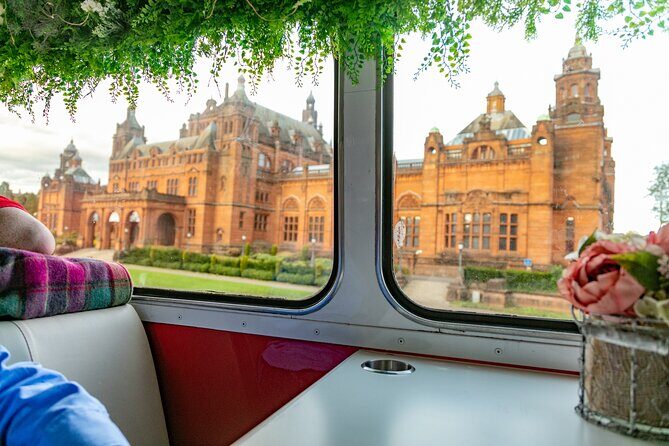
This is afternoon tea, but the setting is the point. You start on a vintage Routemaster bus, sit down, and treat the ride like a moving break from sightseeing pressure. I love that the experience is designed for people who want city highlights without committing to a long walking day.
The food program is the real anchor. You get handmade sandwich selections, a warm scone served with cream and jam (and a strawberry garnish), plus petit fours and cupcakes. On top of that, tea and coffee are unlimited, so you can linger over the second cup instead of hunting for a café.
The best part is that you’re not stuck only looking inward. You’re also taking in Glasgow’s sights from the bus while the crew keeps things upbeat. If you like your travel days a little playful and a little efficient, you’ll feel at home quickly.
You can also read our reviews of more tours and experiences in Glasgow.


Getting On Board at Shuttle Street and Finding Your Seat
Your meeting point is 36 Shuttle St, Glasgow G1 1QA. It’s a convenient spot if you’re using public transport, and you’ll want to arrive 10–15 minutes early because the bus has limited time at the stop.
Seating is where you should be realistic. The bus is vintage, so it’s not laid out like a modern tour coach. A few people noted that some rows can feel snug, and the top/front area may be tighter depending on how the seating plan works that day.
There’s also a key expectation to understand: this is set up so that you may need to share a table, particularly on busier weekend tours. If you’d rather not share, it’s worth asking about seating on a quieter run when you book.
What You Eat and Drink on the Bus: Sandwiches, Scones, Sweets
The afternoon tea spread is the main reason to do this. You get handmade sandwiches, a home baked warm scone with cream, jam, and strawberry garnish, and then a solid line-up of sweets: petit fours and cupcakes. I like that the mix covers both savory and sweet so nobody leaves hungry.
Tea and coffee are unlimited. That matters more than it sounds, because it turns the meal into a slow-down moment. It also helps on cool days when you want something warm in your hands while you watch the city roll by.
Dietary needs are handled with advance notice. There are gluten-free and vegetarian options available, but you should specify requirements at reservation time because products may contain nuts. If you’re traveling with allergies, this is one of those experiences where your prep before you arrive pays off.
No Full Narrated Tour: How the Commentary Actually Feels
Here’s the big expectation-setting point. The format is a dining experience while touring, and it does not run as a full narrated tour with constant live or recorded commentary. In practice, you might hear some pointing-out from the crew, and the mood can include things like a singalong, but it’s not built like a step-by-step history lecture.
That’s why the vibe can feel two ways, depending on what you wanted. If you came for the food plus a relaxed city overview, it tends to land well. If you came expecting detailed facts at every turn, you may feel like something is missing.
I think the best way to enjoy it is to treat the bus route like a guided map made of viewpoints. You’ll see neighborhoods and major buildings quickly, then you can choose what to explore later on foot or with a museum visit. It’s a great “set your bearings” approach, especially if it’s your first day in Glasgow.
George Square, City Chambers, and Tolbooth Steeple Views
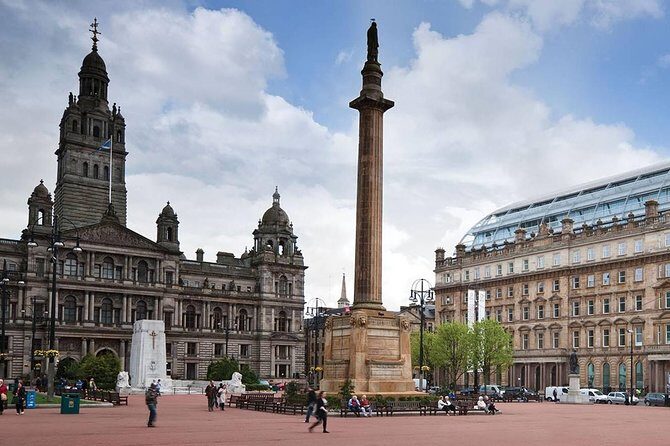
The bus route starts feeding you classic Glasgow civic scenes. One of the early big visual hits is George Square and the City Chambers. The building is described as a focal point of George Square, and it reflects the wealth and industrial prosperity of the city’s past.
From there, you’ll pass Glasgow Cross highlights, including the Tolbooth Steeple. It’s one of the area’s most important features, topped with a clock and a stone crown. The steeple also traces back to the larger Tolbooth building that housed roles for the town clerk’s office, council hall functions, and even the city prison.
I like these moments because they give you immediate context. You see how Glasgow grew, not just what it looks like today. Even if you’re not staying long in the center, these structures help you understand the city’s “serious building” side.





Glasgow Cathedral and the Necropolis: Gothic Edges and Big Stories
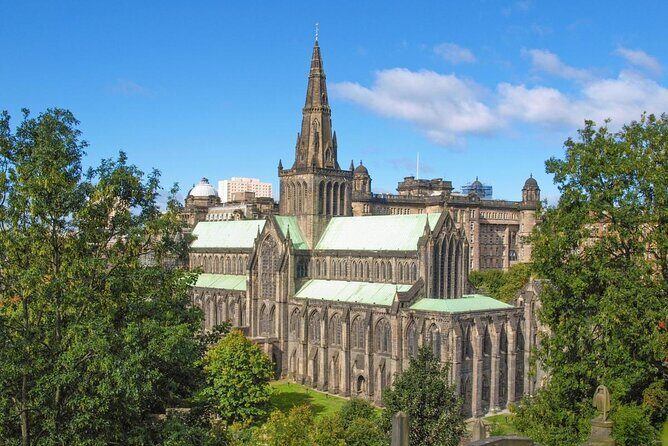
Glasgow Cathedral is another major stop on the route. It’s noted as Scotland’s magnificent medieval building that survived the Reformation in 1560 intact on the Scottish mainland. That kind of survival turns a photo into more than decoration, because you know you’re looking at something that has lasted.
Next comes the Necropolis, a Victorian garden cemetery known for architecture, sculpture, and stories. It’s modeled on Père-Lachaise in Paris, and the numbers given are striking: around 50,000 burials with roughly 3,500 tombs.
This area is a good example of why the bus ride can be worth it even without long explanations. You’re not just passing landmarks; you’re seeing how Glasgow handles memory, identity, and place. If you want to take it further later, this is where you’ll likely be glad you got an early overview.
Kelvingrove Art Museum, Doulton Fountain, and People’s Palace
The route moves into Glasgow’s museums and cultural stops. Kelvingrove is described as a world-class art museum where artworks are displayed, borrowed, and collected from around the world. The museum is a natural match for people who want a taste of high culture without scheduling your whole day around one venue.
Right in the Kelvingrove Park area, you’ll also encounter the Doulton fountain. It’s described as the largest fountain ever constructed in ceramic, and it was originally one of the major attractions at the 1888 International Exhibition, an event that drew more than 5.7 million visitors.
Then there’s People’s Palace on Glasgow Green. It focuses on how Glaswegians lived, worked, and played, using objects, photographs, prints, and film. I like that this stop balances the grand buildings and museum collections with everyday life, because it gives you a fuller feel for the city’s social side.
Tennent’s Wellpark and the Tolbooth-to-Taps Glasgow Feel
This is Glasgow, so you’ll also get brewery energy on the route. The bus passes Tennent’s Wellpark Brewery, described as part of Scottish culture for generations and producing award-winning brews since 1885.
You also get a classic pub moment in the city center with Tennent’s Bar. It’s framed as a local favorite for great beers, tasty food, and lively banter, and it’s one of the last traditional pubs in Glasgow’s West End. Even if you don’t stop inside during the tea service, seeing where the pub culture sits helps you plan where to go after.
Kingston Bridge, Clyde Arc, and Finnieston Crane: Glasgow’s Engineering Street Cred
Some of the most impressive views on the route are the bridge-and-industry moments. Kingston Bridge carries the M8 motorway through the city center, and it’s described as one of Europe’s busiest, with around 150,000 vehicles per day. That’s the kind of scale you only grasp when you see it from the street.
The Clyde Arc is the other big engineering highlight. It spans the River Clyde and connects areas from Finnieston near the Clyde Auditorium and SEC to Pacific Quay and the Glasgow Science Centre in Govan. The description calls out its curved design and the way it crosses at an angle.
Finnieston Crane is another standout from the engineering heritage side. It’s a disused giant cantilever crane retained as a symbol of Glasgow’s industrial past, and it was used to load cargo, including steam locomotives, onto ships bound for export. If you like industrial design or shipping history, this is where your camera will probably get used a lot.
Armadillo and the Hydro: Modern Icons on the Scottish Event Campus
As the route reaches the waterfront cluster, you’ll see the SEC Armadillo. It’s described as a purpose-built venue and a Glasgow landmark, designed by Foster + Partners, opening in 1997 as part of a new era for the SEC and Glasgow’s waterfront.
Nearby is SSE Hydro, a multi-purpose indoor arena within the Scottish Event Campus. It was initially named The Hydro after a main sponsor, Scottish & Southern Energy subsidiary Scottish Hydro. These buildings are useful as orientation points, too, because they anchor the newer part of the city on the river.
I like how this shift from cathedral-and-civic stone to modern arena architecture keeps the ride interesting. You’re seeing Glasgow’s shift in ambition over time, all in one continuous loop.
Whisky, Riverside Museum, and Science Centre Views Along the Clyde
You also pass Glasgow’s whisky story. The route includes the city’s first dedicated Single Malt Scotch Whisky distillery in over 100 years, with a visitor experience, café, and a specialist whisky shop. Even if you don’t go in during your tea service, it’s a clear signal of where the city is taking its modern identity.
Then there’s the Riverside Museum, described as Glasgow’s award-winning transport museum with more than 3,000 objects on display. The range is broad, from skateboards and locomotives to paintings and prams, with a playful note that even a Stormtrooper appears among the collection.
You’ll also see Glasgow Tower as part of the Glasgow Science Centre complex. For families and science-curious adults alike, it’s a good “after this, go do that” cue.
And yes, this whole stretch works nicely if your feet are tired. You get river views and major cultural stops without the fatigue of long walks between them.
Hunterian Art Gallery, University of Glasgow, and the Mitchell Library
The later part of the bus route leans more academic and arts-focused. The Hunterian Art Gallery is highlighted for its distinguished public art collection, including works ranging from Rubens and Rembrandt to the Scottish Colourists and the Glasgow Boys. If your interests run toward painting and Scottish art movements, this gives you a strong lead for a future museum day.
Next is the University of Glasgow, framed as a place changing the world since 1451. It’s linked to famous names such as Adam Smith, James Watt, and Lord Kelvin, and it emphasizes modern work by today’s world-changers.
Finally, you’ll pass the Mitchell Library at Charing Cross. It’s part of Glasgow Libraries’ network and is described as containing some of the finest collections available to any public library. It’s also noted as accessible for research, inspiration, and enjoyment.
I love routes that include libraries and universities. They make a city feel more than just scenery, and they give you a sense of where the serious thinking happens.
Practical Tips for a Smoother, More Comfortable Ride
A little prep makes a big difference on a vintage bus. First, remember there is no toilet on board, so use facilities before you board. One guest mentioned a bathroom break partway through, but don’t plan your day on that happening every time.
Second, expect no A/C. One review described it as hot with no A/C, and the presence of fans is noted. If you’re doing this in warm weather, wear breathable layers and bring a small hand fan or a damp wipe if you like to freshen up.
Third, if you dislike sharing tables or you’re uncomfortable in your assigned seat, ask the crew early. They may be able to help you move around or adjust seating within the constraints of the bus.
Finally, if loud music bothers you, know that the vibe can include upbeat tracks and singalongs. If you’re sensitive to sound, pack earplugs. It’s a simple way to keep the fun without losing your comfort.
Should You Book This Glasgow Afternoon Tea Bus Tour?
I’d book this if you want a single-ticket way to combine afternoon tea with a fast city overview, without spending the day walking. It’s especially strong as a first-day outing, a birthday treat, or a “my feet need a break” plan.
I would not choose it if your main goal is a deeply narrated history tour with constant commentary. This is dining-forward, and the bus tour elements are more about quick highlights than thorough storytelling at every stop.
If you like your travel days warm, sweet, and lightly silly, this has the right ingredients.
FAQ
How long is the Glasgow afternoon tea experience?
The tour lasts between 70 and 90 minutes, depending on conditions.
What’s included with afternoon tea?
You get handmade sandwich selections, a home baked warm scone with cream and jam (with strawberry garnish), a selection of petit fours, sumptuous cupcakes, and unlimited tea and coffee.
Is there a guide commentary while you drive?
The company states they do not offer live or recorded guide commentary on the buses. It’s set up as a dining experience while touring, with possible light commentary or a singalong.
Do they offer gluten-free or vegetarian options?
Yes. Gluten free or vegetarian options are available, and you should specify your needs when you book. Products may contain nuts.
Is there a toilet on the bus?
No. There is no toilet on board.
Will I share a table?
You should expect to share a table, especially on busier weekend tours. If you would rather not share, the company says they can try to accommodate you on a quieter tour.
Are service animals allowed?
Yes, service animals are allowed on the tour.