REVIEW · GLASGOW
Glasgow Street Art Daily Walking Tour: 2pm
Book on Viator →Operated by Walking Tours in Glasgow · Bookable on Viator
Street art in Glasgow is everywhere, if you know where to look. This walking tour strings together major pieces on the city’s mural trail and turns quick street sightings into real stories. You’ll get a guided route that covers a couple of miles at a relaxed pace, starting near Glasgow Central.
I especially like how the tour gives you names and context—artists like Rogue One, Art Pistol, Smug, and even a tribute to architect Charles Rennie Mackintosh. I also love the pacing: it is structured in short stops, around 10 minutes each, so you can actually watch, look up, and absorb what you’re seeing.
One thing to consider is that this is an outdoor walk that depends on good weather. If skies are rough, the operator may move you to a different date or refund you, so plan a little flex time.
In This Review
- Key takeaways before you go
- The 2pm Glasgow street art walk: what you are really buying
- Starting at The Lighthouse area: where the tour begins (and why it matters)
- Walking reality check: pace, group size, and what to wear
- Stop 1 on the mural trail: Wind Power (#12) and artist Rogue One
- Stop 2: Bubbles (#19) and a fresh collaboration
- Stop 3: The World’s Most Economical Taxi (#10) and Rogue One’s city icons
- Stop 4: The Clutha Bar stop and the Charles Rennie Mackintosh homage
- Stop 5: Mural Trail #.09 Billy Connolly on a huge scale
- Stop 6: Falling Mural by The Rebel Bear and the look-up challenge
- Stop 7: Smug and Fellow Glasgow Residents mural street art
- The guide makes it: how explanation turns walls into stories
- How the $19.42 price stacks up for value
- Tickets, language, and practical logistics you should plan for
- Should you book the Glasgow Street Art Daily Walking Tour at 2pm?
Key takeaways before you go
- Small group (max 20): easier to hear the guide and keep the walk feeling personal
- Seven mural stops in about 1.5 hours: short, focused segments with time to look up and around
- Real artists, real collaborations: Rogue One shows up across multiple pieces, plus Art Pistol and Smug
- Meet near Glasgow Central: start at 81 Mitchell St, with The Lighthouse as the landmark focus
- No paid entry at the stops: each listed stop is free to view
- English-only tour: guided explanations are built for an English-speaking group
The 2pm Glasgow street art walk: what you are really buying
At $19.42 per person, you are not paying for a museum ticket or a big bus ride. You are paying for a focused route through Glasgow’s street art and, more importantly, for an interpreter who helps you read it. Street art can look like a random explosion of color when you pass it quickly. On this tour, it becomes a trail with names, themes, and local connections.
The sweet spot here is time. The experience runs about 1 hour 30 minutes to 1 hour 40 minutes, which means you can fit it into a typical day without burning half your itinerary. Since the route covers a couple of miles on foot, it is long enough to feel like you saw more than just one wall, but short enough that you will still have energy for the rest of Glasgow.
The other value play is how the itinerary is set up. It is built from specific mural trail numbers—like #12, #19, and #10—so you’re not guessing. You are being guided from one standout piece to the next, with the guide explaining what inspired each work.
You can also read our reviews of more walking tours in Glasgow
Starting at The Lighthouse area: where the tour begins (and why it matters)
The meet-up point is 81 Mitchell St, Glasgow G1 3LN, and the tour is scheduled for 2:00 pm. Highlights note that it is a short walk from Glasgow Central, and that The Lighthouse is the key landmark for meeting.
That location matters because it keeps the tour low-friction. If you are arriving by train or already spending time around the city center, you do not need a long transfer. You can just orient yourself, grab a coffee nearby, and join the group.
The tour ends at 69 Ingram St. That detail is useful because you might get out of the walk in a slightly different pocket of the city than you started. In practice, it can help you turn the experience into an easy follow-on stroll rather than feeling like you have to retrace your steps.
Walking reality check: pace, group size, and what to wear
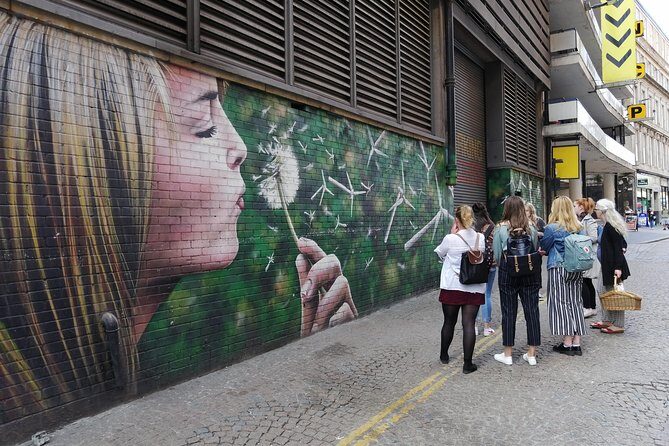
This is a moderate pace walk for about a couple of miles. Each stop is around 10 minutes, which usually means you are standing briefly, listening, then moving on. If you are someone who likes to pause for photos and actually read the details, the short-stop structure helps. If you are sensitive to wet pavement, have shoes with decent grip.
Group size is capped at 20 travelers. That limit matters more than it sounds. In a small group, you are more likely to hear the guide clearly at each stop, even when the wind is trying its best to ruin everyone’s hair and focus.
Weather is the other big factor. The experience requires good weather. If the weather turns, you should expect rescheduling or a full refund. So if Glasgow is serving rain that day, keep a rain jacket handy and remember that street art is best seen when the lighting and surfaces are cooperative.
Stop 1 on the mural trail: Wind Power (#12) and artist Rogue One
The tour starts with Wind Power on the Glasgow Mural Trail, listed as #12. You begin by learning about the mural and the artist Rogue One. Even if you only spot this kind of piece briefly on your own, starting here pays off because it sets the tone for how you will read the rest.
Wind Power is a good opener because it trains your eyes. You start looking for more than color and style. You begin looking for the message the mural is carrying—how the artist uses the scene to connect to people and place. The guide also shares inspiration behind the piece, which changes your experience from looking at street art to understanding why it exists.
A drawback of any street art tour is that some murals are high enough that photos can be awkward. Starting at this first stop helps because the guide usually gets you used to how the route and viewing angles work before you hit the taller murals later.
Stop 2: Bubbles (#19) and a fresh collaboration
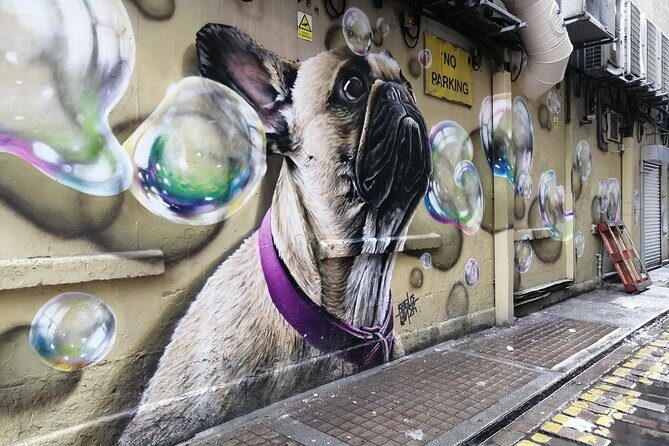
Next up is Bubbles on the trail, listed as #19. This one is described as the newest mural on the trail. It is a collaborative piece from Rogue One and Art Pistol.
This stop is worth it for two reasons. First, it gives you a snapshot of how the mural trail stays alive and changing, not frozen in time. Second, collaboration is a big clue to how street art culture works in Glasgow. It is not just one artist building a personal brand. It can be a conversation between creators, each bringing their voice.
If you are the kind of person who loves seeing how new art blends into the existing visual language of a neighborhood, this is your moment. The guide’s role here is to connect the “newness” to what the piece is trying to say, so you don’t just treat it as a recent decoration.




Stop 3: The World’s Most Economical Taxi (#10) and Rogue One’s city icons
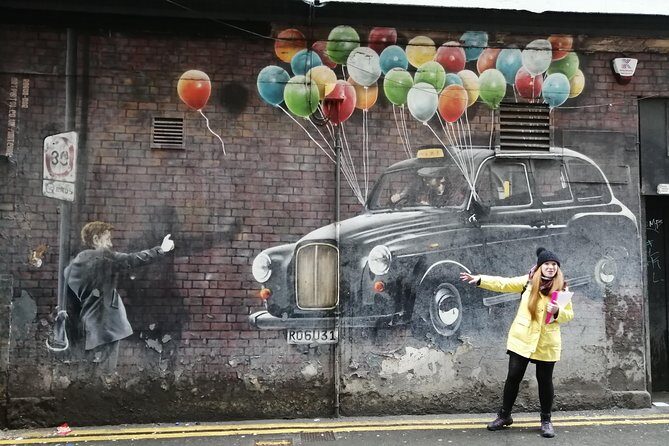
The third stop is The World’s Most Economical Taxi on the trail, listed as #10. This one is iconic in the way it uses a recognizably Glasgow image: the city’s black taxi, depicted by Rogue One.
I like this stop because it bridges the gap between street art and everyday local life. A taxi is not abstract. It is part of how Glasgow moves. When street artists borrow familiar symbols like this, the murals tend to land faster because you already understand the subject.
Also, the guide’s descriptions of inspiration help you catch the intention behind the portrayal. You’re not just seeing a taxi painted big. You’re seeing a symbol turned into social storytelling.
Practical tip: keep an eye out for the details. At quick glance, taxi murals can look like a simple portrait. Up close, you often start spotting stylistic choices that make it feel like more than a sign painted for decoration.
Stop 4: The Clutha Bar stop and the Charles Rennie Mackintosh homage
The walk then takes you to The Clutha Bar. This is one of those stops where street art feels like it has seeped into the street-level culture. You can see a trove of street art from various artists, including a homage to architect Charles Rennie Mackintosh.
This matters because Glasgow’s creative identity is not trapped inside galleries. It shows up on pub walls, in the details around everyday gathering spaces, and in references that local people recognize. When you see a nod to a major architect in street art form, it also helps you understand how design and visual culture connect in the city.
The guide’s storytelling is especially helpful at this stop. A wall of multiple works can feel chaotic if you do not have a thread. With guidance, you can separate what is symbolic, what is historical reference, and what is pure visual style.
A consideration: if The Clutha Bar area is busy, you might find it harder to take photos without stepping around foot traffic. But that is the tradeoff for stopping in a real, lived-in part of town.
Stop 5: Mural Trail #.09 Billy Connolly on a huge scale
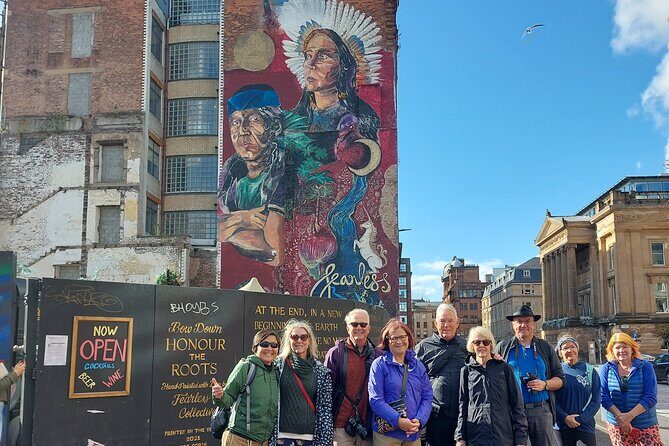
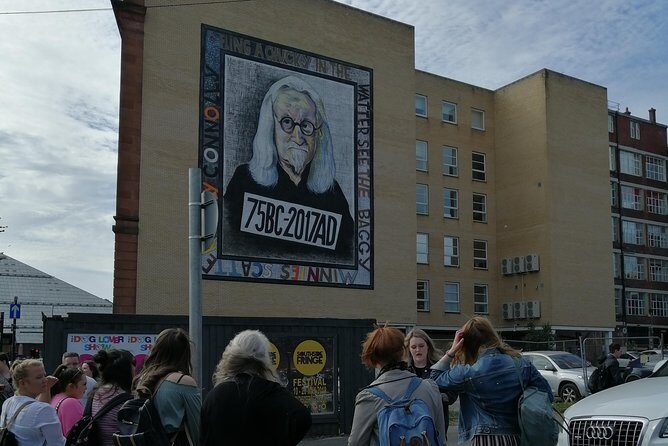
Then you move to Mural Trail #.09, featuring Billy Connolly. He towers above you in a massive mural.
This is a classic Glasgow move: take a local-born icon and scale it up into a public landmark. It is the kind of mural that you could walk past without realizing how much it communicates until someone points out the creative choices. The guide does exactly that, adding explanation about the mural and why it resonates.
I also appreciate this stop because it gives the tour emotional variety. Not every mural is purely political or decorative. Some are celebratory. Connolly’s presence brings a sense of humor and local pride into the walk, so the experience does not feel like you are only studying heavy themes.
If you enjoy pop culture references in public art, you will likely linger here. The height also means you’ll use that built-in skill from earlier stops: look up, then scan for smaller details in the surrounding composition.
Stop 6: Falling Mural by The Rebel Bear and the look-up challenge
Next is the Falling Mural by The Rebel Bear, described as two falling lovers and linked to the nickname Scottish Banksy.
This stop is all about perspective. Two figures in motion are easier to appreciate when you actually look up and track the composition rather than snapping a quick photo and moving on. The guide’s time here helps you notice the structure of the piece—how it creates a sense of movement and mood.
I like that this stop adds emotional contrast. Earlier murals lean on recognizable symbols and local identity. Falling Mural shifts the focus toward romance, tension, or storytelling through imagery. When a tour includes that mix, it feels more like a cultural walk than a single-note slideshow.
One practical note: because this type of work can be higher up, your best viewing spot might change depending on crowd flow and street width. Be patient. A good angle is worth the wait.
Stop 7: Smug and Fellow Glasgow Residents mural street art
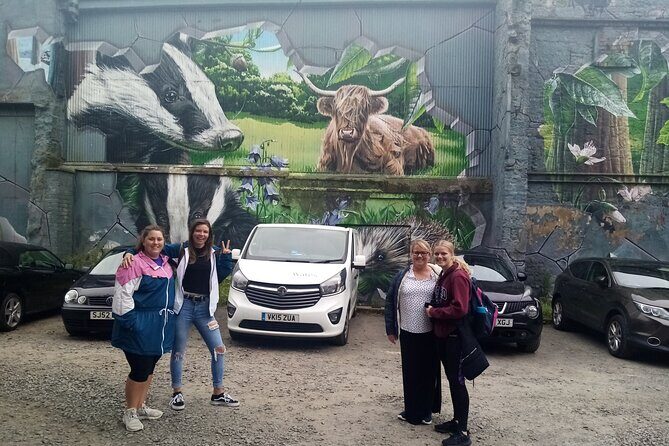
The final stop is described as Fellow Glasgow Residents Mural Street Art, featuring a piece by Smug that depicts Scottish native wildlife.
This is a fitting closer because it rounds out the themes you’ve seen across the trail. You started with wind and murals as messages. You moved through collaborations and city icons. You added local celebrity and emotional storytelling. Then you land on native wildlife, which brings the tour back to place—nature and identity tied directly to Scotland.
Wildlife murals can be especially rewarding if you like spotting small textures—fur patterns, stylized faces, and symbolic choices. Even if you are not a big wildlife person, the idea of Scottish native species shown in public art form is a reminder that street art can be observational, not only confrontational.
By the time you finish, you’ll probably notice something that many people miss on first pass: Glasgow murals often reward repeat viewing. You start seeing that tiny details are doing real work.
The guide makes it: how explanation turns walls into stories
The strongest feedback points to one thing: the guide’s delivery changes everything. Names you might encounter include Claire, Grace, Liz, Gabriel, David, and Caron. Across these guides, a consistent pattern shows up—people praised engaging explanations that connect the art to inspiration and to how social art fits into Glasgow’s wider scene.
In street art, the same style can mean different things depending on context. A guide helps you avoid the common trap of assuming you already understand the mural’s message. They also help you notice newer pieces. One comment highlighted that a guide could speak about art that was only a week or two old, which suggests the operator tracks the trail and isn’t just repeating static facts.
You should also expect humor and energy. Multiple guides were described as entertaining and good at keeping the group interested, even when the weather was wet and windy. That matters because Glasgow weather can turn a photo walk into a cold shuffle. A good guide keeps the tour moving and keeps you thinking, not just shivering.
How the $19.42 price stacks up for value
Let’s put the number in perspective. At $19.42 for roughly 1 hour 30 minutes, you’re paying for a guided walk, a set route, and context for multiple murals. This is especially good value if you plan to spend most of your time in the city center anyway. You do not need to hire a taxi. You do not need to add another attraction to make the tour worthwhile.
The stops are listed with free admission, so you are not layering costs on top of the ticket price. Most of your spend is the tour itself, plus whatever you buy on your own between stops.
If you are the type of traveler who likes to take your photos and move on fast, this might feel like a lot of guidance for a short time. If you enjoy learning and you like walking slowly enough to see details, it’s a strong deal. The group cap helps here too—smaller groups generally mean more time for questions and better listening.
One more value point: the tour books ahead. The average booking window is about 22 days, so it’s smart to reserve early if your schedule is tight.
Tickets, language, and practical logistics you should plan for
You’ll get a mobile ticket. The tour is offered in English, and confirmation is received at booking. It is also near public transportation, which helps you join without complicated planning.
Bring a little street sense. This is a walking tour on city sidewalks, so wear comfortable shoes and expect you’ll be outside for the full experience. Since it covers a couple of miles at a moderate pace, it is not a sit-and-watch activity.
Service animals are allowed, and most travelers can participate. If you have mobility concerns, it is still a good idea to choose shoes carefully and be ready for a steady walk between stops.
Finally, because good weather is required, I treat the tour like a day-trip anchor. If your itinerary has zero flexibility at all, choose another plan as your backup.
Should you book the Glasgow Street Art Daily Walking Tour at 2pm?
Book it if you want Glasgow murals with context, not just photos. This is the right choice for first-timers who want to start noticing street art on their own afterward. The mix of named artists and distinct stops—Rogue One pieces like Wind Power and the taxi mural, collaboration with Art Pistol, Smug’s wildlife work, plus the Connolly scale-and-celebrate moment—keeps the route varied.
Skip or reconsider if you hate outdoor walks or you know your day is locked to bad weather. Also think twice if you dislike guided storytelling. This tour’s value lives in the explanations, so you’ll get the most from it if you like learning while you walk.
If you’re deciding between several city activities, this one is a smart “high impact” option. It gives you a compact route, a small group feel, and a way to read the walls that you’ll see later even after the tour ends.