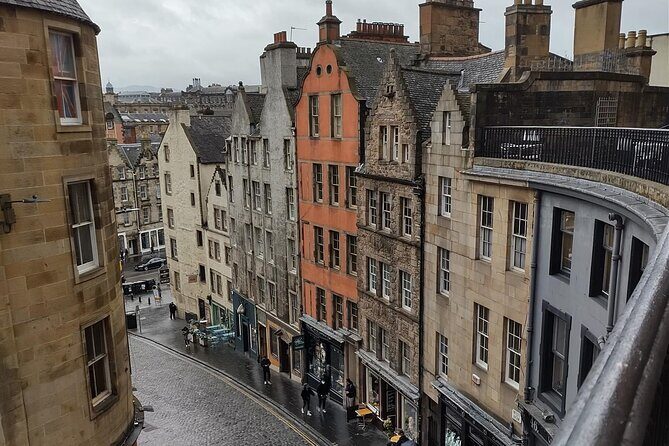
Glasgow comes alive with a guide who has jokes. In a small-group walk with Johnny, you’ll learn the city’s “Mother Glasgow” story through landmark buildings, steeples, and odd traditions that turn ordinary street corners into scenes. I love the 15-person max pace, and I love how the route connects the dots from Glasgow’s civic swagger to its cathedral-and-necropolis drama.
One heads-up: this is an outdoor-heavy route with lots of ground covered in about three hours, so if you want long sitting breaks, plan for standing and frequent steps.
In This Review
- Quick hits before you go
- Getting Your Bearings: from Royal Exchange Square to Glasgow Cathedral
- The Small-Group Advantage: 15 people keeps the tour personal
- Mother Glasgow: why the story thread makes the whole walk click
- Stop-by-stop: Duke of Wellington and George Square’s rooftop ship
- Duke of Wellington Statue: cones and a tradition with attitude
- George Square: Glasgow’s civic heart and that rooftop ship
- The forgotten Georgian thread and the city’s rise-then-reshuffle
- Trongate to Glasgow Cross: Tron Kirk Steeple, the grottiest stories, and Tolbooth Steeple
- Trongate: near Tron Kirk Steeple
- Tolbooth Steeple: epicentre of Old Glasgow at Glasgow Cross
- St. Mungo at High Street and Provand’s Lordship: street art plus a small blue portal
- St. Mungo at High Street
- Across from Provand’s Lordship: four special buildings and the small blue one
- Glasgow Cathedral and the Necropolis view: the medieval climax
- The stuff that makes it better than a quick photo walk
- Price and value: why $16.64 can feel like a steal
- Who should book this Glasgow City Centre walk, and who might pass
- Should you book Gander Walking Tours in Glasgow?
- FAQ
- How long is the Gander Walking Tours Glasgow experience?
- Where does the tour start and end?
- What time does the tour run?
- What language is the tour offered in?
- How big is the group?
- Do I need to buy admission tickets for the stops?
- Is the ticket mobile?
- Is free cancellation available?
Quick hits before you go
- Johnny’s owner-led, story-first approach: props, photos, and nonstop city talk that keeps the walk moving.
- A tight city-centre loop: George Square, Trongate, Glasgow Cross, and Glasgow Cathedral in one run.
- Quirky Glasgow details you’d miss solo: cone-wearing on Wellington, a rooftop ship on George Square, and strange side-stories attached to big buildings.
- Most stops are free to enter: you’re paying for guiding time, not entry fees to attractions along the way.
- A take-home list of where to eat and drink: you’ll get recommended pubs, museums, and experiences after the tour.
- Family-friendly in real-world ways: stroller is workable, and the pace stays human even when it’s cold or wet.
Getting Your Bearings: from Royal Exchange Square to Glasgow Cathedral
This is a straightforward Glasgow city-centre walk designed for orientation. You start outside near Royal Exchange Square (8–10 Royal Exchange Square, Glasgow G1 3AB) at 10:30am, and the tour ends at the Glasgow Cathedral area around Castle Street (Glasgow Cathedral, Castle St, Glasgow G4 0QZ). The route stays concentrated, so you don’t lose energy on long transfers.
Plan for a solid three hours of walking. Stops are mostly short—often only a couple minutes to grab the story, then you’re moving again. That’s a feature, not a flaw. You’ll leave with a mental map: where the civic center sits, how Glasgow Cross connects streets, and why the Cathedral area feels like the city’s grand finish line.
You can also read our reviews of more walking tours in Glasgow



The Small-Group Advantage: 15 people keeps the tour personal
The cap is 15 travelers, and that matters more than it sounds. With a small group, Johnny can actually talk to everyone, keep an eye on the pace, and tailor the conversation when questions pop up. You’ll feel included rather than processed.
From the way the tour runs, you can also tell the guide is prepared for street-level reality. You’ll hear clearly even with city noise, and there’s a sense of careful planning about where the group pauses and when you’ll go past shops and working spaces without getting in the way.
If you like tours where the guide knows what you care about, this is that kind. If you hate talking and want silence, you might find it a lot—but for most people, that energy is the point.
Mother Glasgow: why the story thread makes the whole walk click

The big theme is Mother Glasgow—described as Scotland’s powerhouse—and the tour keeps returning to how the city grew, changed, and reinvented itself. That’s more useful than it first seems. Without a story thread, you can end up collecting facts about buildings. With a story thread, you start understanding how the city behaves.
Johnny’s “Glasgow Gander” framing turns history into something you can picture. You don’t just hear dates. You learn how industrial expansion shaped neighborhoods and civic pride, then how decline forced reinvention. Even when you’re standing in front of a monument, you’re being pointed back to the larger arc: commercial city swagger, industrial grit, then a renaissance that still shows up in the architecture and street character.
And yes, the tour mixes serious changes with humor and odd details. That blend is why the walk feels fun rather than like a lecture.
Stop-by-stop: Duke of Wellington and George Square’s rooftop ship
Duke of Wellington Statue: cones and a tradition with attitude
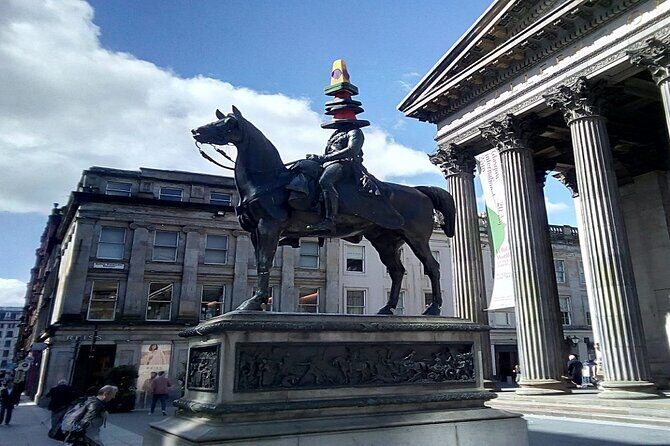
The walk kicks off with the Duke of Wellington Statue. The highlight here is the tradition of modern Glasgow cone-wearing by the commander. It’s the kind of playful city ritual that sounds small until you understand it as part of local identity—Glasgow’s sense of humor, its thrift-and-stunt creativity, and its talent for turning street life into a story.
This stop is short, but it’s a smart opener. You get the tour’s tone quickly: quick facts, a clear visual, and a reason why locals treat certain things as meaningful.





George Square: Glasgow’s civic heart and that rooftop ship
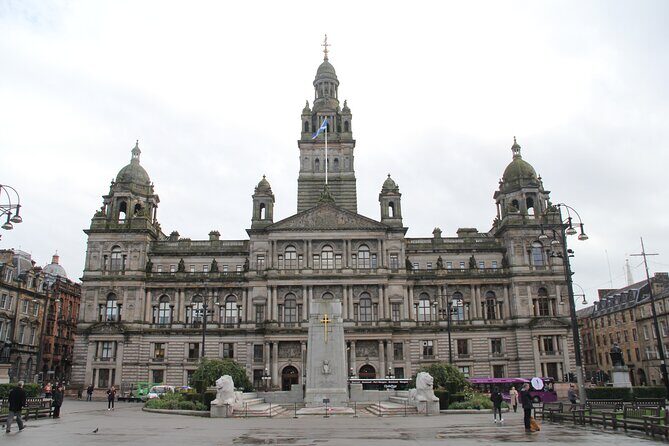
Next comes George Square, the symbolic heart of the city. Here you’ll focus on civic architecture—especially Glasgow City Chambers, one of northern Europe’s finest civic buildings. You’ll also get a fun scavenger-style task: watch for the unpredictable movement of a rooftop ship.
That rooftop ship detail is a great example of what this tour does well. It teaches you to look up. When you’re in Glasgow, a lot of the story sits in upper-level features—balconies, rooftops, carved details, and weird little surprises.
If it’s windy or raining, this stop can feel exposed because you’re outdoors in open square space. Just dress for that and you’ll be fine.
The forgotten Georgian thread and the city’s rise-then-reshuffle
Between the big open-square sights and the steeples, the tour pivots into Georgian Glasgow and the darker comical side of what people built and enabled. You’ll hear about an often-overlooked Georgian gem and a club where pig-like gluttony was encouraged. It’s odd on purpose. Glasgow’s past includes these kinds of human habits—social rules, class behavior, and venues that reflect what a city rewards.
Then the walk moves into the shadow of one of the city centre’s striking buildings to talk about Glasgow’s growth as a commercial and then industrial city. This is where the Mother Glasgow theme becomes practical for your trip. You’ll hear about decline, renaissance, and the legacy of the city’s powerhouse identity—plus how that continues to affect the world today.
If you’re the type who reads museum plaques and then forgets them, this is still useful. The tour gives you a way to connect what you’ll see elsewhere during your stay, not just what’s on this route.
Trongate to Glasgow Cross: Tron Kirk Steeple, the grottiest stories, and Tolbooth Steeple
Trongate: near Tron Kirk Steeple
Trongate is an ancient thoroughfare where you’ll pick up another layer of Glasgow’s street character. Near the 16th-century Tron Kirk Steeple, Johnny tells the story of an incredible hidden entertainment venue—described as grotty in the best way. The point isn’t just the venue. It’s how Glasgow’s entertainment culture grew in unlikely spaces, how “ordinary streets” became social stages.
You’ll also understand why Trongate matters for a first-time visitor: it’s a corridor where older layers of the city sit close to newer life.
Tolbooth Steeple: epicentre of Old Glasgow at Glasgow Cross
From there you reach Tolbooth Steeple, beneath the 17th-century structure where several major streets meet: Trongate, Saltmarket, London Road, Gallowgate, and High Street. This is Glasgow Cross, an epicentre of Old Glasgow.
This stop is about scale and junction logic. Standing at a street intersection like this makes you realize Glasgow’s growth wasn’t random. It funneled people—workers, shoppers, travelers—toward economic and cultural pressure points. If you like urban history that feels tangible, this is a good one.
The downside? Intersections can be loud and busy, so if you’re sensitive to noise, you’ll want to keep your attention on the guide. Johnny handles it by keeping you oriented and speaking strongly so you don’t lose the thread.
St. Mungo at High Street and Provand’s Lordship: street art plus a small blue portal
St. Mungo at High Street
A quick stop next: St. Mungo at High Street. This is where you’ll see Glasgow’s most famous son hiding in plain sight, with one of the best street art pieces around.
It’s a two-minute moment that pays off later. Once you’ve spotted street art like this, you start seeing how Glasgow mixes old identity with modern expression. For photographers, it also gives you a strong visual anchor in the middle of a walk full of architecture.
Across from Provand’s Lordship: four special buildings and the small blue one
Then you’ll stand across from Provand’s Lordship, described as the city’s oldest house, and look at four special buildings. One detail in particular gets people talking: a small blue building that’s sometimes used for inter-dimensional travel.
Even if you don’t treat that detail literally, it’s a perfect Glasgow-style clue. The city leans into playful storytelling. You’ll notice it in street-level art, weird signage, and buildings with personality instead of just grand monuments.
The caution here is practical: you’re outside and looking around at multiple small-scale features. If you’re trying to rush, you’ll miss things. Slow down at this stop so you can actually spot what the guide points out.
Glasgow Cathedral and the Necropolis view: the medieval climax

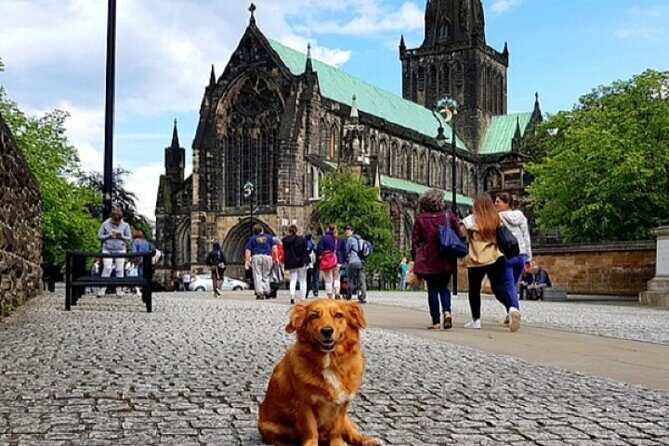
The final major stop is Glasgow Cathedral, positioned with the Necropolis behind it. You’ll get the medieval, Scottish Gothic architecture, plus that dramatic Victorian contrast created by the city of the dead.
This is the part of the walk that makes the full route feel worth it. Earlier stops teach you how Glasgow functioned and organized itself. Here you see how it expressed power and belief through grand stone, then how the city extended that story into burial grounds and landscape-adjacent drama.
One real-world detail: depending on COVID restrictions on group size and mask-wearing inside the cathedral, the tour may finish outside rather than inside. So don’t count on long time in the building. Either way, you’ll still get the architectural payoff plus the viewpoint energy toward the Necropolis.
The stuff that makes it better than a quick photo walk
There are a few “extra” elements that push this beyond a basic sightseeing loop.
First, the tour uses props and visuals. You’ll see photographs passed around and other small aids that help you connect the dots on buildings. That matters in cities like Glasgow, where architectural features can be easy to overlook from street level.
Second, there’s a local taste involved. Johnny has a drink for the group to try, including Irn Bru. This is small, but it makes the stories feel lived-in instead of bookish.
Third, the guide takes care with other people’s space. You’ll benefit from his habit of scouting where the group will go before entering spots, so you’re not barging into businesses or disturbing locals.
And after the walk, you’ll get an emailed list of what to do next—museums, pubs, and recommendations. One example called out is the Step Bar, but the bigger value is that you’ll leave with a practical next-day plan rather than a pile of vague ideas.
Practical tip: bring a pen and paper. The tour gives a lot of information, and having notes helps you remember not just what you saw, but why it mattered.
Price and value: why $16.64 can feel like a steal
At $16.64 per person for about three hours, the price sits in the budget-friendly zone for a guided walk. The value gets better because many stops are listed as Admission Ticket Free. That means your money goes to the guide’s time and the quality of interpretation, not to stacking paid entries.
Also, the small-group cap adds weight. If you’ve ever done a big “herd” tour, you know the difference between hearing the guide and actually understanding the city. Here, the format supports a real conversation, and you can ask follow-up questions without feeling like you’re waiting your turn for a microphone.
If you’re short on time in Glasgow, this is also a smart buy. It’s not trying to replace museums. It’s trying to help you understand what you’ll later see on your own.
Who should book this Glasgow City Centre walk, and who might pass
Book it if you:
- Want a fast way to learn Glasgow’s layout in the centre
- Care about architecture, steeples, and how civic buildings reflect power
- Like humor mixed into history, not history-only
- Want practical local recommendations after the walk
- Need something workable with a stroller (the tour is described as baby-friendly)
You might pass if you:
- Don’t like walking for long stretches with frequent stops
- Prefer quiet tours where you can just absorb without discussion
- Expect lots of deep indoor time at each stop (the route is largely outdoor, and cathedral time can vary)
Should you book Gander Walking Tours in Glasgow?
Yes, if your goal is a strong first feel for Glasgow city centre. This tour is built around a clear theme (Mother Glasgow), a tight route, and a guide who treats the walk like a guided conversation instead of a checklist.
If you’re trying to decide between a self-guided stroll and paying for a guide, this is the kind where the guide changes what you notice. You’ll start looking up for details, you’ll understand why intersections and squares matter, and you’ll leave with an actual plan for the next day.
If you’re in Glasgow for only a day or two, this is one of the simplest ways to make your time feel fuller without burning energy on complicated logistics.
FAQ
How long is the Gander Walking Tours Glasgow experience?
It lasts about 3 hours.
Where does the tour start and end?
It starts at 8–10 Royal Exchange Square, Glasgow G1 3AB, UK, and ends at the Glasgow Cathedral area on Castle St, Glasgow G4 0QZ.
What time does the tour run?
The start time is 10:30am.
What language is the tour offered in?
The tour is offered in English.
How big is the group?
The tour has a maximum of 15 travelers.
Do I need to buy admission tickets for the stops?
The listed stops are marked as admission ticket free.
Is the ticket mobile?
Yes, it includes a mobile ticket.
Is free cancellation available?
Yes. You can cancel up to 24 hours in advance for a full refund. If you cancel less than 24 hours before the start time, the amount paid isn’t refunded.