REVIEW · GLASGOW
Fun Glasgow City Centre Walking Tour Guided
Book on Viator →Operated by Gallus Pedals · Bookable on Viator
Glasgow makes more sense on foot. This guided city-centre walk strings together social and political landmarks, major architecture, and story-heavy stops in about two hours. I like the way the guide gives you a fast sense of Glasgow’s contemporary culture alongside the older, deeper stuff, and I also like the built-in photo breaks that help you leave with more than just names. One thing to consider: it is a group walk, so you’ll want to be comfortable moving at a steady pace for the full 2 hours to 2 hours 10 minutes.
You’ll be in a small group, capped at 20 people, and the setup is geared toward extra attention when groups run smaller. Based on what people highlight, the guide mix of humor, clear explanations, and practical tips is the big reason the tour feels like more than a checklist. I’d call the one drawback the typical trade-off: this is orientation-focused, not a slow, linger-at-everything tour.
You start at the Donald Dewar Statue area on Buchanan Street (G1 2NG) and finish back in the Cathedral area on Castle Street (G4 0QZ). The tour includes entry at Glasgow Cathedral and the Necropolis, while the other stops are free—so your time budget stays simple and predictable.
In This Review
- Key highlights that make this walk worth your time
- Why this Glasgow city-centre walk fits real travel days
- Donald Dewar Statue: the launch point for contemporary Scotland
- Nelson Mandela Place and George Square: social themes, radical movements, and modern context
- A dedicated photo moment for Glasgow’s architectural treasure
- University of Strathclyde: the story of free education and global impact
- Gallery of Modern Art: the building, the city’s character, and how Glaswegians see themselves
- Glasgow Cathedral finish area: where the tour ends and you choose your next step
- Necropolis: a famous graveyard stop with guided stories that add life
- Guide style matters: Gallus Pedals, humor, and practical recommendations
- Price and value: what $41.15 gets you in the real world
- What to do before and after the walk (so it lands well)
- Who this tour suits best
- Should you book this Glasgow city-centre walking tour?
- FAQ
- How long is the Glasgow city centre walking tour?
- How much does the tour cost?
- Where does the tour start and end?
- What language is the tour offered in?
- Is the tour ticket mobile?
- What’s included in the tour admission-wise?
- Are food and drinks included?
- Is transportation included to or from the meeting points?
- How big are the groups?
- Can I cancel for a refund?
Key highlights that make this walk worth your time
- A story-led route that connects social history to modern Glasgow in a way that feels usable
- Gallus guide energy, with humor and real orientation tips (people often mention the guide by name: Connor)
- Included Cathedral and Necropolis entry, which saves hassle and adds weight to the finish
- Great photo stop planning, including a dedicated moment to capture an architectural treasure
- Small group size (max 20), which helps you ask questions and get clearer answers
Why this Glasgow city-centre walk fits real travel days
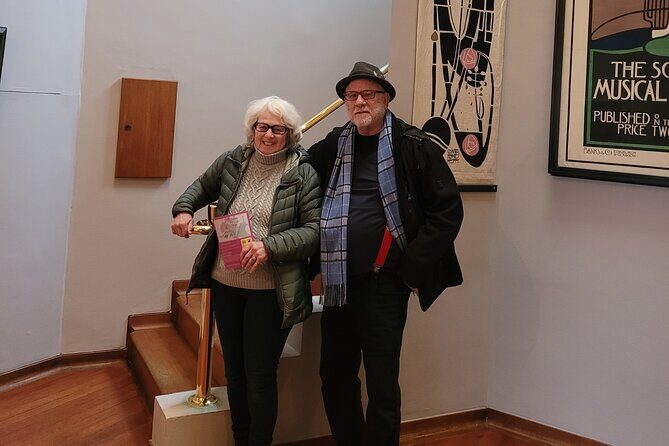
This tour is short enough to fit into most itineraries without stealing your whole afternoon. At roughly 2 hours to 2 hours 10 minutes, you get a focused overview of the city layout and the main neighborhoods you’ll want later.
The value is not just that you visit famous spots. It’s that the guide stitches them together into a single thread: Scotland’s present-day feel, Glasgow’s big social themes, and the city’s identity as seen through landmarks. If you’ve ever wandered around a city feeling like you saw buildings but didn’t understand them, this type of structure helps you get your bearings fast.
Also, the guide doesn’t treat you like a passive audience. People mention clear guidance on what to do next, which is exactly what you want when your schedule is tight. And because the group is limited to 20, you’re less likely to get lost in the shuffle.
You can also read our reviews of more walking tours in Glasgow


Donald Dewar Statue: the launch point for contemporary Scotland
The walk starts at the Donald Dewar Statue on Buchanan Street. This is not just a meeting point. The guide uses it to introduce contemporary Scotland, giving you an early lens for how the rest of Glasgow’s stories will connect.
Why that matters: first impressions set expectations. By the time you move into the rest of the route, you already have a framework for what you’re seeing—so the architecture and public spaces start to feel purposeful rather than random.
This is also an easy beginning for first-time visitors. You won’t need to know anything ahead of time to follow the thread, and it’s positioned right in central Glasgow where you can easily plug the rest of your day around it.
Nelson Mandela Place and George Square: social themes, radical movements, and modern context
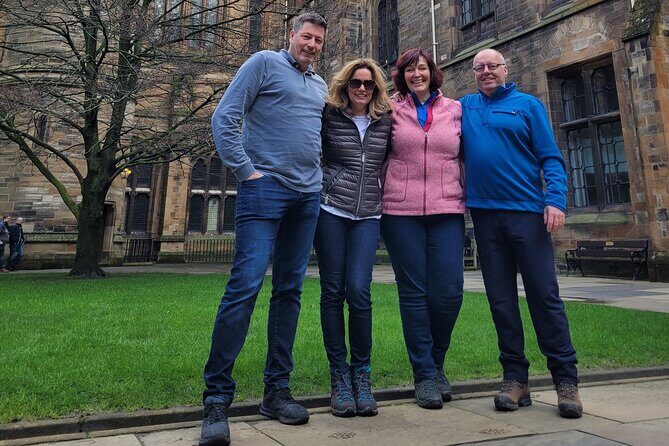
From the statue area, the next stop is Nelson Mandela Place, where the guide covers the social and historical significance of the location. Expect a short, guided explanation meant to make the place click, not a long museum-style lecture.
Then the tour heads to George Square for a deeper orientation moment. Here, you get a historical overview of the square and how it connects to famous radical movements, plus a guide-led look at contemporary Glasgow.
I like this pairing because it covers both ends of the spectrum—symbolic history and present-day city identity. George Square is the kind of place where you can stand and just look around, but the guide helps you read the symbolism and the city’s mindset. That makes later independent time easier: you’ll know what you’re noticing and why it matters.
Potential drawback: because each of these stops is relatively brief (think around 10 to 15 minutes), you should treat the tour as an intro. If you’re the type who wants to spend an hour in one location, plan to return later on your own.
A dedicated photo moment for Glasgow’s architectural treasure
In the middle of the route, the guide builds in time for what they describe as a chance to get your best shot of an architectural treasure. There’s a specific pause for photos here, so you’re not constantly scrambling while listening.
This matters for two reasons. First, you’ll get a clearer idea of what landmarks look like from the right angles. Second, it prevents the common problem where a walking tour tells you where to stand but never gives you the time to actually take the photo.
If you’re traveling with a phone camera or a real camera, use this moment to check your settings and clear your shot list. You’ll thank yourself later.
University of Strathclyde: the story of free education and global impact
Next up is the University of Strathclyde. The focus here is Glasgow’s tradition of free education for all and how educational institutions contribute beyond Scotland.
Even if you don’t plan to tour university buildings afterward, this stop works well for understanding Glasgow. It’s one of the themes that explains how the city thinks about opportunity and learning, and the guide frames it in a way that feels connected to the rest of the walk.
Why this is a good stop on a short tour: it adds a practical social lens. Instead of just seeing monuments, you’re seeing what shaped people’s lives and ambitions.
Time check: you should expect this to be about 15 minutes, enough to orient you without turning the tour into a school history class.
You can also read our reviews of more guided tours in Glasgow


Gallery of Modern Art: the building, the city’s character, and how Glaswegians see themselves
The route then includes a stop at the Gallery of Modern Art. The guide explains the history of the building and connects it to the unique character of Glasgow and Glaswegians.
This stop is especially useful if you’ve heard Glasgow described as tough, funny, or proud, but you want a concrete way to connect that reputation to something you can see. Modern art spaces are often where a city shows what it values right now, not only what it valued decades ago.
Expect this to be another around 15-minute segment—enough to give you context and a few takeaways, but not so much that you feel stuck away from the street life.
If you want to go deeper, use the tour as the primer, then return later if you’re still curious.
Glasgow Cathedral finish area: where the tour ends and you choose your next step
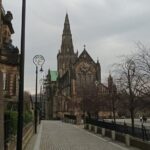
The final stretch brings you to Glasgow Cathedral, with included time and included admission. This is where the tour returns to end, and it’s also where you get a choice: you can stay and explore the Cathedral or other nearby local attractions, or your guide can escort you back toward the city centre (with a helpful link back toward George Square).
This is a smart way to end. Cathedral areas tend to reward a slower pace, and you don’t want to force that kind of atmosphere into a clock-based routine. By finishing here, the tour gives you a natural transition from guided storytelling to self-directed wandering.
If you’re the kind of traveler who likes to keep moving right after a guided session, the fact that you can walk back with the guide helps you avoid that awkward moment of wondering where to go next.
Necropolis: a famous graveyard stop with guided stories that add life
The walk also includes a stop at the Necropolis, described as arguably Scotland’s most famous graveyard. Here, the guide adds life to the stories of those buried there.
Even though this is a somber setting, guided explanation changes the experience. You don’t just see headstones and names—you get narrative context that helps the place feel human rather than distant.
This is also one of the included-admission segments, so you get more value than you would from a purely exterior pass. Plan to slow slightly during this stop even though the schedule is tight. The whole point is that this isn’t only about sight-seeing; it’s about understanding what you’re looking at.
Guide style matters: Gallus Pedals, humor, and practical recommendations
People consistently point to the guide as the reason the tour feels like a real experience, not a moving slideshow. Names show up in feedback—Connor is mentioned as awesome—and the themes are consistent: a blend of history, culture, architecture, and orientation.
Here’s what I think you should expect if you like guides who work:
- Clear storytelling that connects the stops instead of treating them like separate checkboxes
- Humor mixed in so the facts stay easier to remember
- Photo-aware guidance so you don’t miss angles
- Personal recommendations for what to do after the walk, in true Gallus style
That last point is practical. A city walk can fail when it gives you facts but no next steps. This one aims to help you keep momentum.
Price and value: what $41.15 gets you in the real world
At $41.15 per person for about two hours, this is priced like a solid city orientation tour—not a budget freebie, but also not priced like a full-day excursion.
You get value in a few ways:
- A characterful guided experience with stories, humor, and photo stops
- Included admission at Glasgow Cathedral and the Necropolis
- A small-group setting (max 20) that makes it easier to ask questions
- Practical follow-up recommendations so you can use the rest of your time well
Not included items are straightforward: no food or drinks, no transportation to or from the meeting/end points, and your own personal expenses. The tour is about walking and learning, so plan your meals separately.
If you’re traveling with tight timing, this structure is also a win. You’re not paying for long idle time or for big travel legs.
What to do before and after the walk (so it lands well)
To get the most out of the tour, I’d plan your day like this:
- Wear comfortable walking shoes. The route is central, but you’ll still be on your feet for the full session.
- Bring your camera or phone and make sure it’s ready for the architectural photo pause.
- Have a plan for your Cathedral-area time after the tour ends. That’s when your self-directed wandering will feel most rewarding.
Afterward, use the guide’s recommendations to pick a next stop nearby rather than jumping across town. The whole point of a city-centre walking tour is to give you a usable map in your head.
Who this tour suits best
This is a great fit if:
- You want an overview of Glasgow without spending the whole day on logistics
- You like guided context that connects landmarks to social themes and modern identity
- You enjoy photo stops and want help turning sights into memories
- You want included admission at the Cathedral and the Necropolis without planning it yourself
It may be less ideal if:
- You prefer long, slow visits inside each landmark during one outing
- You don’t like group pacing (even with smaller groups, it still stays group-paced)
Should you book this Glasgow city-centre walking tour?
Yes, I’d book it if your goal is to understand Glasgow quickly and enjoy the city with better direction afterward. The combination of small-group size, story-led stops, and the included Cathedral and Necropolis entry makes it feel like you’re getting more than just a walk to famous spots. If you care about architecture, want photo-ready guidance, and like guides who bring both clarity and humor, this one fits well.
If your travel style is strict DIY and you already know exactly which sites you want to hit in detail, you might not need a guided thread. But for most visitors, this is an efficient, high-value way to turn a handful of landmarks into a real sense of place.
FAQ
How long is the Glasgow city centre walking tour?
It runs for about 2 hours to 2 hours 10 minutes.
How much does the tour cost?
The price is $41.15 per person.
Where does the tour start and end?
It starts at Donald Dewar Statue on Buchanan St, Glasgow G1 2NG, and ends at Glasgow Cathedral, Castle St, Glasgow G4 0QZ.
What language is the tour offered in?
The tour is offered in English.
Is the tour ticket mobile?
Yes, it uses a mobile ticket.
What’s included in the tour admission-wise?
Admission is included for Glasgow Cathedral and the Necropolis. Other stops are listed with free admission.
Are food and drinks included?
No. Food and drinks are not included, though the provider says they can recommend great places nearby.
Is transportation included to or from the meeting points?
No. Transportation to and from the start and end points is not included.
How big are the groups?
The maximum group size is 20 travelers.
Can I cancel for a refund?
Yes, free cancellation is available up to 24 hours before the experience start time for a full refund.
If you tell me your travel dates and what else you want to do in Glasgow that day, I can suggest a simple before-and-after plan around the Cathedral-area finish.